
The Pope, pets and children: What makes us selfish?
One of the last things we want to think of ourselves as is selfish. The upheaval following Pope Francis’ address on the approach to motherhood in this generation points to a wider narrative.

Elle Sweden October 2015. Photographer: Boe Marion, Model: Camilla Christensen
CHALLENGING MOTIVE
There are few things that rattle us for better or worse like controversial public comment.
Earlier this month, the Pope addressed a general audience in the Vatican on matters of having children, commenting ‘We see a form of selfishness. We see that some people do not want to have a child. Sometimes they have one, and that’s it, but they have dogs and cats that take the place of children’.
For women of all generations and schools of thought, this caused a stir. Is selfishness truly the root cause of women having less or no children? Although Pope Francis’ analysis of societal trends may be accurate, the motivation he claims behind comes across as insensitive and reductionist.
Feeding further into stereotypes of millennials opting for comfort and self-satisfaction over sacrifice, these broad statements lead us to a bigger question: Does having children rescue us from being selfish?
IS MOTHERHOOD THE ANSWER?
Becoming a parent is without a doubt a reorientation of priorities. Practically speaking, for a baby to flourish it has to be put first by its carer and have its needs met in a loving way. This requires patience and new heights of multitasking, but it doesn’t solely mark out a road to selflessness or virtue.
Part of the angst generated from this conversation is that for some, natural parenthood has not been an option. Through infertility and baby loss, many experience feelings of shame, guilt and even a lack of femininity through situations that are beyond control or reason.
For others, motherhood is a path that will not be walked for a myriad of reasons, many of those reasons a far cry from absorption in self.
If a high profile person of faith highlights selfishness, are we somehow compelled to become selfless? Is motherhood the antidote?
A NEED TO EXPLAIN
Rather than ‘cancelling’ the Pope, perhaps a better approach is recognising that choice and circumstances are not the measurement of whether we’re deemed selfish. As women, it’s hard not to feel like the conversation hits a nerve, though. Knowing we are equal to and gifted as our male counterparts, why does this comment feel personal?
To many women, justifying ourselves is an old friend. Why we’ve chosen our career, walked away from a friendship or chosen a certain partner can all be reasons to send us into a monologue of explanation. The motherhood conversation has the same effect.
Whether it’s explaining to a well meaning relative why we may not have children, or feeling guilty for starting a family in the ‘prime’ of our work, we expend a lot of energy making sure others don’t think we’re selfish or misguided.
POLARISING FAITH
Irrespective of choosing parenthood, pets or faith, we can’t better ourselves away from human nature. Part of our frailty as humans is that even though we can demonstrate great altruism, we naturally bend towards self.
In an already polarised landscape, it’s easy for faith to be rejected, especially by women, when it is combined with sweeping statements about something as tender as starting a family or adopting. When we value feminism, Pope Francis’ outlook can make faith seem like it is cold and callus. Still, there is hope.
ACCEPTING IMPERFECTION
We are not inherently bad or irreparable, but we are imperfect. Frankly, we are all selfish from time to time, whether we have children or not.
The description of that imperfection according to The Bible is not our inability to be selfless or abide by rigid thinking, it’s simply that we can’t make the grade in our own strength, ‘For everyone has sinned; we all fall short of God’s glorious standard. Yet God, in his grace, freely makes us right in his sight’ (Romans 3:23-24 NLT).
Whatever your perspective on the comment made by the Pope, the good news is that it’s not the opinion of others that we’re here to pacify or appease.
It’s through the grace and truth of God, not the judgment of others, that we experience love that transforms how we see ourselves and others. This doesn’t remove us from selfishness, but embraces us through it and enables us to grow. That has nothing to do with our parental status.
WORDS BY:
Rachel Calland
GOT OUR LATEST EDITION?
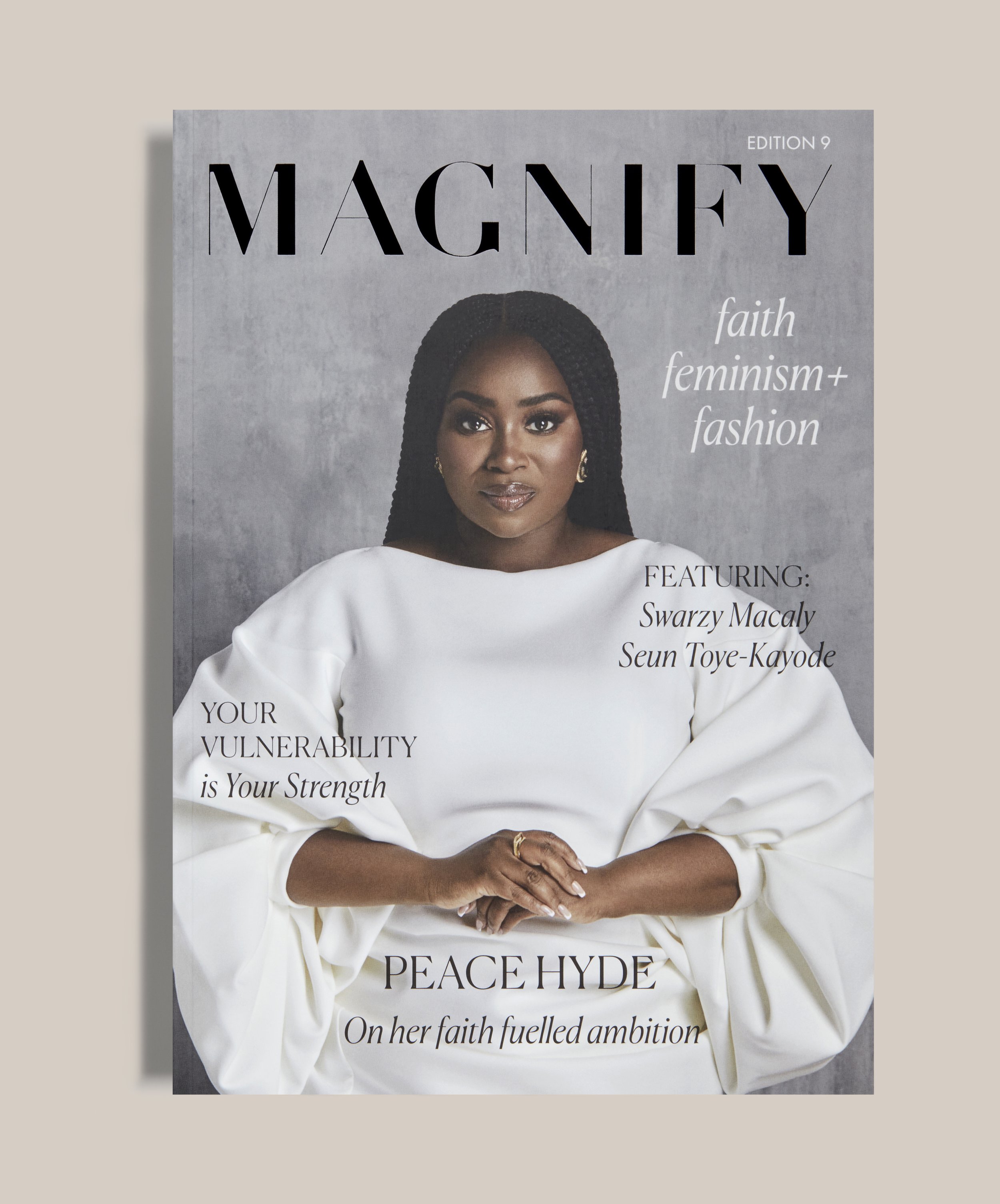

Your vulnerability is a strength.
This Edition is dedicated to the theme of vulnerability. Often we are told that we must choose between being strong or vulnerable. This can lead to us hiding our vulnerable side in fear of being seen as less than by those around us. This is why we wanted Edition 9 to tell the stories of women who are proving that cultivating ambition and vulnerability is both necessary and possible.
On our cover, we are honoured to feature Peace Hyde, a media entrepreneur. Peace’s story is one that shows great intention which has led to incredible achievements, including being the Head of Digital Media & Partnerships for Forbes Africa and the creator of the first African reality show on Netflix, Young, Famous & African. In her interview, she shares the moments of uncertainty which have required her to be honest with herself, and how her faith has directed each step in her career.
Through each interview and article, Edition 9 shows how, when we embrace every dimension of who we have been created to be, we make room for authenticity and joy in every area of our lives.
